
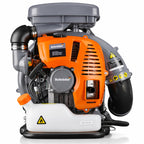

Leaf blower safety starts before the engine does: read the correct manual, inspect the equipment, prepare the work area and select protection for the conditions. If you cannot keep the work area clear or control where debris goes, postpone the job or change your method.
This is a planning guide, not a replacement for the manual, workplace training or a site-specific hazard assessment. Canadian homeowners and grounds crews may use similar machines, but a paid crew also needs to follow its employer's procedures and applicable local requirements.
Prepare a job you can control
Walk the area with the blower off. Identify access points, neighbours' spaces and the intended collection location. Make a separate decision about each surface. A quiet lawn, a shared walkway and a driveway with parked vehicles do not present the same working conditions.
Check the machine using its manual's inspection procedure. If something is loose, leaking, damaged or unfamiliar, resolve it before use. Our maintenance checklist can help organise your notes, while Schröder Canada support can help identify the relevant model information.
Keep fuel-powered equipment outdoors
Never run a gasoline blower inside a home, garage, shed or other enclosed space, even with a door open. Fuel-burning equipment can produce carbon monoxide. Follow Health Canada's carbon monoxide prevention guidance; an indoor “quick test” is not a safe shortcut.
Choose protection for the actual task
The Canadian Centre for Occupational Health and Safety recommends eye protection and hearing protection when using blowers, with respiratory protection where dust or mould exposure requires it. Use the CCOHS blower safety checklist alongside your manual and the site's assessment.
Do not treat a photograph of protective equipment as a specification. The right fit, condition and selection matter. If you are unsure what protection a task requires, ask a competent person before proceeding. A product's airflow rating does not answer questions about noise exposure or airborne material.
| Check | Question to answer | If the answer is unclear |
|---|---|---|
| Equipment | Do I have the correct manual and understand the controls? | Get model-specific instructions. |
| Protection | Is it appropriate, intact and correctly fitted? | Resolve selection or fit before work. |
| Work area | Can I control access and the direction of debris? | Change the plan or wait. |
| Unfamiliar material | Do I know what I am disturbing? | Do not blow it; arrange an appropriate assessment. |
Protect the space around the operator
Keep people and animals out of the work area, direct the nozzle away from them and vulnerable objects, and operate from stable ground. Do not use a blower from a ladder or roof, or to distribute chemicals. These precautions are covered in the CCOHS guidance on blowers; apply the separation distances required by your manual and site procedures.
Plan how you will notice someone entering the area. A path that looks empty at the start may become busy later. Stop when the boundary changes rather than expecting another person to understand your intended route. Do not begin a pass that depends on pedestrians moving out of the way.
Make stopping part of the plan
- ReadUse the manual for the exact machine.
- InspectCheck equipment and prepare appropriate protection.
- AssessConfirm the work area and collection route.
- RecheckStop and reassess when conditions change.
Schedule the job so pausing is possible. An unfinished patch is easier to deal with than a situation you no longer control. Keep the support number and model details somewhere accessible without needing the machine running.
For grounds crews, hearing protection belongs within a wider noise-management approach. See the CCOHS hearing conservation programme overview when reviewing workplace responsibilities with your supervisor.
Common leaf blower safety questions
Can I use a blower on unknown dust or renovation debris?
Do not assume it is ordinary yard material. Stop and identify the material and suitable handling method before disturbing it. This guide does not assess hazardous dust.
Where should a first-time owner begin?
Start with the supplied manual, then use the Schröder Learning Hub for model-relevant setup videos. Videos complement written instructions; they do not override them.